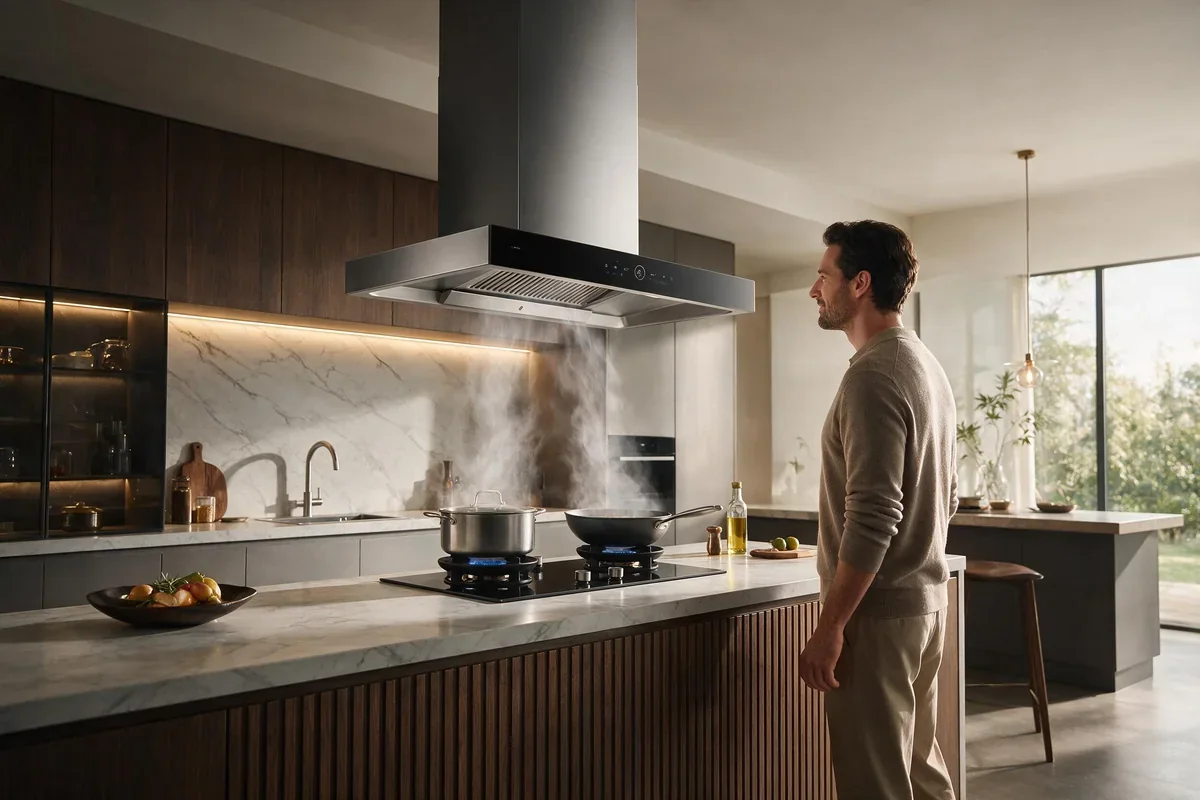
Low airflow from a Fisher & Paykel rangehood is worth checking from the filters outward: a grease-loaded filter, a saturated carbon filter on a recirculating hood, or a duct run that restricts the air. If the filters are clean, the duct is sound and the fan still does not respond at its speed buttons, it needs diagnosis.
A Fisher & Paykel fault is most useful when it is tied to the right appliance family and exact model. This guide explains what to record, which owner-safe checks may be appropriate, and when the problem should move to professional diagnosis.
Low ventilation airflow can come from user-maintenance conditions, installation constraints or a fan/control fault. Record the exact model, speed behavior and filter condition before separating accessible maintenance from technician diagnosis.
Fisher & Paykel has used multiple generations of DishDrawer, ActiveSmart refrigeration, laundry and cooking platforms. Similar displays or code labels do not guarantee identical components or identical troubleshooting steps. Use the full model/product code whenever it can be read without disassembling the appliance.
This is why the page separates what can be observed safely from what must be tested on the appliance by a qualified service professional.
The installation guides for two Fisher & Paykel chimney hood families say the hood must never be used without its filters in place. The aluminum filters should be cleaned at least once a month, more often depending on how much you cook, in hot soapy water or in a dishwasher with the filter upright so food does not fall on it. Refit them only after rinsing and drying.
The guides also treat grease as a safety matter: deposits on the fan or filter are corrosive, and there is a fire risk if cleaning is not done as instructed.
A photo of the display and model label is often more useful than a long guess about the failed part.
Use only the checks described for the exact model in Fisher & Paykel user/support documentation. Owner-safe actions normally stay at the level of accessible filters, visible supply conditions, control settings, door/drawer position, power state or other items the manufacturer explicitly exposes to the user.
Do not remove live electrical covers, open sealed refrigeration systems, bypass sensors or safety devices, force a locked oven door, perform gas-system work, or substitute a generic internet reset for a model-specific procedure.
| Symptom | What it can point to | What you can check |
|---|---|---|
| Weak suction and a greasy filter | Grease loaded into the aluminum filter | Remove and wash the filter as the guide describes, then refit it dry |
| Weak suction on a recirculating hood | A saturated carbon filter | Check how long it has been in use against the guide’s replacement interval |
| Weak suction and noisy airflow | A restrictive duct run, or flexible duct | Look at the accessible run only; do not open walls or panels |
| Low airflow at speed 1 only | A low speed setting selected | Try speeds 2 and 3 on the control panel |
| No fan response at any speed | A control or fan fault | Check the circuit breaker and book diagnosis |
Request diagnosis when the fault returns after documented owner checks, when the appliance cannot complete its normal function, or when the issue involves internal electrical, heating, sealed-system, gas, pump/motor, control or safety-related diagnosis.
If there is smoke, sparking, a strong electrical smell, uncontrolled water leakage, abnormal overheating or another condition that may be unsafe, stop normal use and address the safety condition before routine troubleshooting.
An error code usually identifies a fault category or condition. It is not automatically proof that a specific sensor, board, valve, motor, compressor, heater or other component must be replaced. The repair decision should come after the actual appliance is checked in the correct model context.
A recirculating hood uses disposable carbon filters, and the pyramid chimney guide says to replace them at least every six months depending on use. A saturated carbon filter becomes a barrier to air movement and limits performance, so weak airflow on a recirculating hood can point straight at it.
A ducted hood must always vent outdoors. The box chimney guide recommends 6 inch (152 mm) rigid or semi-rigid duct with the shortest and straightest run possible, because that reduces noise and increases airflow. Flexible ducting is described only as a last resort, and metal ductwork only. A long, bent or flexible run is an installation question, not a repair one.
A concise request should include the appliance type, model code, exact symptom, displayed fault and service address. If the appliance still operates intermittently, describe what usually triggers the problem. If the issue appeared after installation, a move, plumbing work, a power interruption or a network change, include that detail without assuming it is the root cause.
Only when the manufacturer documentation explicitly covers both models. Otherwise treat procedures as model-specific.
Record the complete code or indicator state first whenever it is safe. Repeated resetting can erase useful context without fixing the underlying condition.
That is usually a poor first step. Similar symptoms can have different causes, and parts compatibility depends on the exact model/product code.
No. This is an appliance repair resource and service site.
The installation guides for two chimney hood families say at least once a month, and more often depending on cooking. Hot soapy water or a dishwasher are the methods described.
No. The guides say never to use the hood without the filters in place, so leave the hood off until they are refitted.
The box chimney guide says to pull the catch and tilt the filter downward until it disengages from the supports. Follow your own model’s guide, since latch designs can differ.
Use the booking form with the exact appliance, model code if available, symptom, displayed code and service address. Service availability should be confirmed before an appointment is promised.
Secondary context: official legacy manuals and product resources.
Technician-community reports may inform diagnostic hypotheses but do not replace manufacturer code definitions or safety guidance.
The model and serial label on a Fisher & Paykel appliance sits in a different place on each product type: inside the cabinet on…
A model being called current or legacy describes its documentation and catalogue status, not whether it can be repaired. The exact model code decides…
First find out whether the appliance still does its normal job without the app. If it cooks, cools or washes normally, the problem sits…
Share a few details and we’ll confirm an appointment. Prefer to talk? Call us and we’ll help right away.
Fields marked with * are required.